
At a Glance
The Meaning Review is my personal nook for publishing fiction and non-fiction. The title is intentional: it invites a closer look at what we take to be meaningful in our lives. This is not an academic or scientific journal, but a collection of stories and reflections.
Why I started The Meaning Review
For years I have been working as a software engineer. Nevertheless, that busy schedule couldn’t suppress my need for writing. Besides that, the forties brought up questions that could no longer be swept under the rug. One of them is: How to break the illusions of the contemporary world and start a quest for meaning? In my case, those were the illusions about science. I expected that science would keep its promise and solve many more problems than it actually did.
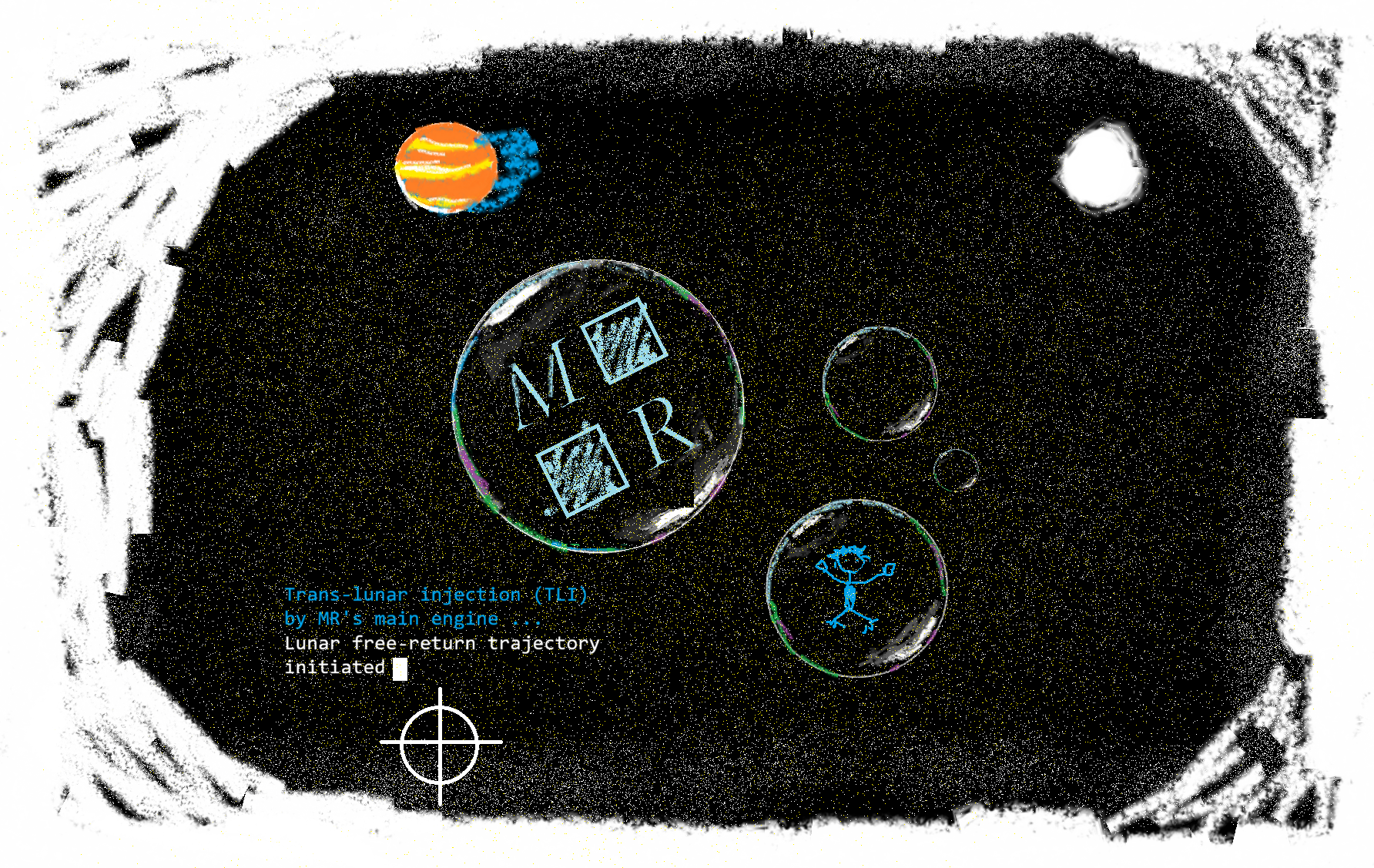
A man drifting in a bubble of illusion, seeing no meaning.
Let’s stop for a moment and step into the bubble of an illusion I was drifting in until recently. If we think a little more soberly, we will realize that science by itself doesn’t give false promises. That is, in fact, what the false promoters and prophets of science do, and we sometimes do the same under their influence. When the spiritual crisis of civilization advances, false authorities emerge more and more, and their agitations become more convincing. The real-life examples of this will largely serve as a motivation for the stories I publish here. Also, this phenomenon is not limited to science, but is present in other fields as well, perhaps to a greater extent. Science is mentioned only as an example I am familiar with.
Once we realize that we have been tricked, we reject false authorities, and everything from then on gets some different, better meaning. However, reaching the moment of awakening is not simple at all—a point noted long ago by some true authorities—because one must face oneself first, specifically one must face one’s own illusions. Likewise, I needed a lot of time to recognize that my attitude toward science was wrong, and to find some new meaning.
Written word helps in breaking illusions.
In that regard, I have received some very interesting and meaningful explanations from people whose specialization is completely different from mine—people from the world of culture (applied arts, literature, etc.). Sometimes it is much easier when they direct you to the relevant literature and help in understanding it.
For instance, I really liked the explanation of irrational authority given by Erich Fromm. That kind of authority does not motivate, but rather carries out torture. An example could be a professor who wishes to humiliate their students, rather than inspire them to learn.
Furthermore, Carl Jung explains in his work why one should face oneself. Reading it was a transformative experience. The existence of unconscious, negative tendencies that people often project onto others (what Jung calls the projection of the shadow) calls on all of us to re-analyze our behavior. It is implied that his teachings go far beyond breaking illusions only.
Having received some guidelines coming from the world of culture, I plan to follow them in my writing. Of course, my goal is not to become an expert on some form of culture (although I would like to)—that requires years of diligent work—but rather to engage with it from an engineer’s point of view. Actually, that is why I created my own micro-world—this nook of creative writing, The Meaning Review—all while running a software agency in Barcelona.
For publishing content, I use the pseudonym Johnny B, after the song of the same name performed by The Hooters. In that song Johnny B is chasing dreams, but is also trapped in his own illusions. Maybe he represents a prototype of the future young man haunted by AI. Who knows! In any case, that musical plot is an appropriate introduction to the content of this website, which will, I hope, be of some help at least to someone in their quest for meaning.
To conclude in true radio-speaker fashion, we’re going back to the sixties to get a running start and a meaningful jump to the twenty-first century—or what’s left of it—with The Beatles’ song about the man who wants to become a writer, Paperback Writer. When I think too much about my writing, I let The Beatles make fun of it. This song simply keeps me from the illusion of being Dostoevsky.
April 07, 2026