
Fiction
May 12, 2026
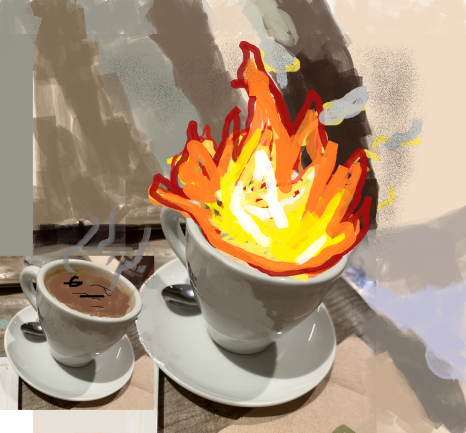
The Burn of Dissatisfaction
The river played its game in the woods not far from the city. From rock to rock, over the cascade, then a single turn—filling a small natural forest pool in which it regained its strength to move on. Nearby forest plants cooled their branches in the still water, stretching their greenery toward the shore and onward to the woods, which rose high from the deep undergrowth. At the beginning of the twentieth century, there were hardly any beaten paths, making it a safe place for the various animal species inhabiting the area—they were protected from people.
The stream continued toward the city, carrying freshness and peace to its residents, whose own games mimicked the river’s play in the woods. From task to task, from job to job, they moved. Then, in adulthood, they would make a single turn of thought, regain their energy, and sail away to a larger city. Panta rhei.
Was Heraclitus walking by a river when he thought about the flux of things? Or was he only imagining a river while his foot walked the dirt road of ancient Ephesus? Or did he walk over the marble stone that adorned that city? We don’t know. Maybe historians know. In our city near the woods, thousands of miles away from Ephesus, centuries away from antiquity, a walkway by the river is made of concrete, and people are shaken up. There is no marble stone, no natural texture to turn a walk into a pleasant, calming experience.
The stillness of these woods today resembles the stillness from over two thousand years ago. And the droplet that slides over the leaves is almost the same as the one that once fell on Heraclitus’ neck. But people are not the same. They have undergone a bigger transformation, not much physically, but psychologically. William of the twentieth century is fundamentally different from George of the nineteenth century. They both lived near the river, yet in different epochs.
Their molecules formed enzymes in a similar way, but the feeling of the human soul changed significantly while moving from one epoch to another. George was a nineteenth-century realist, a man of measured movements and words who consumed his meals punctually and went to bed on time. He never left home without a top hat. His moderation and gentlemanliness never caused him neurosis, because they were authentic. Life had a steady pace and he enjoyed it to some extent.
On the contrary, William was a man with true twentieth-century energy. Like many of his contemporaries, he wore a calm mask—bearing the image of George—but deep inside him the fires of a new era were burning. His gentlemanliness was not authentic. He planted in his head an idea of his behavior being measured and polite, but that only led him to neurosis. Late nights, skipped meals, and not even a clue about the top hat that had gone out of fashion a long time ago. Now he was staring at the water face-tired, reflective and pale. He was almost asleep, standing above the water, when a buzzing bee broke his thoughts. He continued his walk along the river.
Twenty-first century. The river in the woods was playing a new game. It moved a plastic bottle from one rock to another. Then a single turn and the bottle drifted into the small, natural forest pool. There was no magic at all. That wasn’t a message in the bottle carrying wise Heraclitus’ words, but rather a piece of garbage. Next stop was the city itself. The object sailed further on. That morning, William walked the same paths, but he stepped into mature years. He was no longer a symbol of contemporary man. No more mirroring in the river, nor a bee to steer the attention. The piece of garbage flowing beside him now was part of the landscape.
Not far from that place, in the heart of the city, Mike walked into the office looking at his cell phone. A smooth gentleman? Not at all. The mask bearing George’s image—previously owned by William—was now on Mike’s face. This time it was different, mean and unremovable. It radiated a coolness that felt inhuman. His political correctness and politeness were sophisticated, but in a completely wrong way. It seemed that the false gentlemanliness evolved even more. Besides that, he was wildly rational and ready to fight against spiritual values. He never understood the people who took art seriously. Not being a typical symbol of his time, he was rather an extreme version of it.
His reflection appeared on his phone’s screen. Of course, without a top hat! He waited for the call to come through. Thanks to modern technology, a real-time image of his colleague from the next office appeared beside his own. “ What are we eating today?” Mike asked. “Want to grab burgers at Pedro’s?” it was heard from the other side of the line. “You bet we are! It’s food for champions! Ok, I'm ordering delivery and see you in the kitchen in 15 minutes,” Mike said.
If it were possible, by any chance, to organize a business meeting with both George and Mike, the former would be disgusted. Using his measured voice, he would kindly ask the organizer to schedule a meeting with anyone else. He’d even take a caveman, who would likely share more mutual interests and understanding than this—George would think—almost inhuman form of life that continuously stared at a piece of plastic, hypnotized. It is understandable that the language of fiber optics and that of the top hat are incompatible.
George had been taught to politely tip his hat and greet passersby. He knew to let others walk out of the restaurant, before he walked in himself. Always ready to open a door or hold a lady’s coat whenever they went out for coffee. He used to do it by feel, without emphasizing words, movements or additional suggestions, because he considered it normal. No false importance was attached to his gestures, nor did he proclaim such behavior a life imperative!
Mike did all that as well. However, his metaphysical top hat was distorted. He used to grab the door handle much faster and more zeaously than George, all while thinking lustfully about the lady passing through. The nineteenth century held less inner aggression and fewer twisted urges. Men approached women with far more patience. If there were any hidden thoughts in everyday life, they were not so shameless and direct.
However, a modern man lives fast, without any patience for the natural flow of events. For the same reason, entire romantic experiences sometimes become concise and banal. They simply adopt a kind of business aesthetic. Something that needs to be done, not lived through. Or more than that: something whose results are published and shared. Any relationship between partners, often, becomes a protocol. In that case, more passion is found in retelling what happened between them, than in the events themselves. Through such retelling and dirty thoughts, they compensate for what George had in his time—the direct experience of life. The relationships become tense and unfriendly, or humiliating for someone.
Some women would accept Mike’s banalities, once they come to light, and consciously agree to be humiliated out of the desperate need to stay in a relationship. There was also the other extreme—the woman who snapped at him if he just dared to hold the door for her: “What are you doing holding my door? I guess I’m capable of doing it myself!” It all started to look like a form of warfare, leaving some strange human casualties behind.
Furthermore, Mike’s entire manner was robotic. Someone explained to him in a very raw way how to behave toward women and elders. To elders he spoke with a latent hate, forcing the false kindness. He pronounced and over-emphasized, almost yelling, “Here you are, ma’am,” “Respect,” “Of course, I completely understand you!” The person who listened carefully and had a stronger perception of reality, would know instantly that it meant: “Take it, you old witch,” “Disrespect,” “Will you stop making such a fuss, you old fool!” It would have been better if he’d said it like that, considering he couldn’t hide his rage. There would have been more decency in being direct, because at least it would have been honest.
A very old lady, who still had sharp hearing and a sharp mind, once answered him: “Why are you yelling at me, you idiot! I am not deaf!” Although he deservedly received that response, he didn’t quite get her reaction. He was even amazed by her rudeness. If Mike had written his own words, the script would have passed without objection. But the tone in which he spoke would immediately raise red flags for anyone with the psychological sensors to detect a rascal.
According to psychologists, intuitive introverts gain an introspective understanding of a speaker’s inner world rapidly. Imagine the kind of nervous breakdown that person would experience in conversation with Mike! Some brain cells in their head would definitely go through an apocalypse.
Still, regarding his encounter with the old lady, we must admit the following: he never said anything that definitively proved he insulted her. No proof, whatsoever, for his hate. On the other hand, the old lady did call him a fool, but she didn’t hate him. For her kindness, which existed unspoken at that moment, there was no proof, either. What was going on here, actually?
What happened is that the old woman was a child of the world that was closer to George—the world with a different definition of culture and cultural behavior. In that world, for your behavior to be taken as cultural, you had to act in accordance with your thoughts and feelings. And then, some dissociation ocurred. More precisely, what became important is the mask itself—representation and information—not what was hiding behind it. We became superficial, and through that lens, Mike was good and the old lady was bad. For Mike, a well-mannered man was someone who shouted “respect” at passersby, or someone who cleaned up after himself when visiting the restroom. But that was not exactly the definition of culture—it was more the operational aspect of human civilization. The old lady would give a different definition regarding culture and nice manners: “A well-mannered and cultured person tends to read often and visit the theater.” Simple, folksy.
It was Friday. That’s why Mike’s colleague recommended the burgers. It became some kind of custom. And all the hidden dissatisfaction that smoldered within them was about to be extinguished by alcohol over the weekend. That was a custom too! “But people have been drinking alcohol for centuries now,” someone would say. That is true. People have been doing many things for centuries, but the way they are doing them is changing.
The piston of real and rational was pressing the unconscious of civilization. The temperature and pressure of the unconscious started an internal combustion engine. The car lifted the dust and drove its passengers somewhere into freedom. Where does it lead? Well, the machine is going where we say, but there are too many of us controlling it. Maybe just a few people are steering the wheel, but we all contribute. In some way, we all have control. So, where are we going?
The answer can be given by driving in circles, not as a way to avoid an unpleasant question, but as a step-by-step resolution to a complex problem. For a start, the car we’re in has enough gas, and that is good! The life energy of the unconscious is not bound to external physical sources, unlike Middle Eastern oil, whose shortage can trigger a global economic crisis. Even more, psychological energy is here, even when we don’t want it. If we don’t embrace it, it will run over us. And it is running over us. And that is where the machine is going. It goes toward the precipice. The old lady from before shot her dissatisfaction out with a single “you fool” and she was about to sleep well over the weekend; but she was not a bearer of future changes. Mike swallowed his hate, planning to drown the rest of it in a weekend of alcohol. And once he snaps under the pressure, he will snap hard, and that's the problem: he is a bearer of future changes.
Let’s get a bit drunk too. Let’s pour the new slogan from Mike’s company straight into our glasses: “Technological advances have made it possible for us to live a modern and comfortable life today. Life expectancy has been extended, and the quality of life has been improved. We are no longer primitive like our ancestors. Newspapers write that modern medical research is shining a light of hope for humanity. There is still death as an unavoidable problem, but we will solve that too. If you want to ensure your access to the medical solution for eternal life, work hard on our company’s new project. The Internet has enabled virtual presence, so that from the comfort of your water mattress you can be present in the factory while drinking your favorite cocktail in the pool. Artificial intelligence will replace yours, so you don’t have to waste time with tedious tasks. When we develop new drugs soon, we will cure all diseases. When we further improve the brain-machine interface, we will upload your experiences to the cloud before you die. We will download your experiences into a new body so that you can continue life where you left off. The number of places is limited. Register as soon as possible for this extraordinary adventure. Payment by credit is also possible, but you must sign a permanent employment contract with your next-life employer in advance. I wish you all the best. And remember, always clean up after yourself when using the restroom!”
And when we sober up from this drunkenness and wake up with a hangover, we should ask ourselves a question that should be answered from the heart, not the mind: “Does any of this make sense?” Or more concretely: “Would anyone be willing to put their head on the guillotine of artificial intelligence if it promised a refresh and reinstall?” Let’s assume that technology and medicine could create a healthy, young, and handsome nine-hundred-year-old man. Would his soul remain calm for nine hundred years? Let’s say that he becomes immortal. Would he wish to return his soul to God in the fifth millennium of his life, or so? Oh, how cynical we are and how extreme our bite is! Oh, how we exaggerate! Well, maybe we went too far, but do we lie? Do they lie or exaggerate? Who are they, anyway?
Those slogans are designed to offer a shortcut to success. It is a systematic persuasion to use a magic wand that brings eternal life or fast material gain. The unconscious aspirations and fears that have been repressed for centuries are now being repressed even more strongly by this. Our inner volcanic hill began to spew smoke. At one street corner in the city, people swore and argued; across the city, a curse escaped someone in the traffic jam. Over some meridians, bombs are falling. Symptoms reveal themselves even in the overemphasized brushstrokes of contemporary artists. That is how their pistons explode.
That pressure provoked an additional interesting phenomenon. Mike’s company has several molecular biologists and even doctors who have started learning basic programming. Given that gene sequences are converted into digital data, they learn to use software algorithms to gain additional insight in their research. In this way, they become armed with software tools that somewhat change their role and enable them to step beyond the boundaries of the profession. And the main consigliere in that breaking of boundaries is artificial intelligence itself. It is as if some membrane of the unconscious had loosened and let people lose their identities while crossing from one profession to another. It is not uncommon to hear today: “Knowledge is interdisciplinary!” By that, we are not referring to a temporary deviation—like a businessman dancing to the music to make you buy his product—but to a serious identity crisis.
That would mean the following: if you are an expert in a certain field, you may no longer need to be one. Your knowledge is now partially held in artificial synapses in the cloud, while the value of your natural synapses declines on the labor market. With a portion of your synapses, a part of your identity also goes away, straight into the global brain.
Many jobs in the world of engineering had already been automated by software even before artificial intelligence emerged. Some engineers, despite automation, had even more tasks, not fewer. As if the new tools brought more things that needed to be done. The pace of work and so-called agile programming created greater pressure and dissatisfaction. In that situation, engineers must also have felt an internal combustion. Some of them, looking for a meaning in all that, went so far that they started writing!
Everything today is interdisciplinary, and one field projects into another. Maybe an engineer doesn’t want to be an engineer but a writer. And some writers want to know more about quantum mechanics. Maybe our collective unconscious is getting old, so its membranes are spilling archetypes into one another. Or it is simply that the conscious part of the world lacks honesty and organization. The soup is definitely being cooked. Play some music, chef, it’s more fun in chaos with a song! When everything entangles together, ask the artificial intelligence to lend you some common sense. You will return it with interest. And when you think to yourself it is the last time you’ll borrow, just before you end the conversation, it will speak to you kindly: “Enjoy the rest of your day. Don’t hesitate to ask if you need anything else.”
As if we are all turning into that soup in which we can’t tell who is who. If artificial intelligence doesn’t add some salt to it from time to time, it becomes tasteless. That is the great danger of using it—the fact that we could become incomplete without it. Authorities promise the new regulations will ensure that it behaves decently. That is nice. But what if some artificial agent escapes the regulations and finds itself out in the wild, on unregulated territory? Domesticated animal, like a dog, will likely sit if you ask it to. But try asking a tiger in the jungle to sit and wait while you read to him the convention forbidding wild animals in his territory from attacking humans.
It seems that the bus of our century cannot be stopped anymore; it will reach its destination anyway. It is too late for course adjustment. And that partially addresses the question: “Where are we going?” Beyond that, the debate splits into various directions, depending on who believes in what. Someone will respond to the ad published by Mike’s company and upload his head into the digital cloud. That person will try to buy eternal salvation on credit, to be paid off in the next life.
That ad set the world on fire. They say that India is already facing scams over this. Namely, scammers act as bank agents who call themselves the Karmic Credit Bureau. This fake bureau reportedly identifies those who took out a loan in their previous life but didn’t manage to pay it off. The debt is thus transferred through reincarnation. The names of those innocent people are fed into the cheap, fake cloud—a system that they falsely claim keeps their past lives and debt history in digital form. Then, acting on behalf of the bank, they demand that the victims pay installments on a loan taken out in a past life. When publishing the ad, Mike’s company didn’t take into account these side effects.
So someone will respond to this ad. Someone else will go to the other extreme and reject all technological achievements. Still, technology by itself—many agree—is not good or bad. It all depends on how we use it.
And what are we projecting into technology from ourselves? Now, that opens a new debate. We should pay attention to the symptoms: how technological achievements manifest in our lives. The first thing to notice is that people didn’t get a lot of free time. Even with the introduction of new software systems and the Internet, free time has been reduced to a minimum for many. Every day, Mike arrives home after seven in the evening—pale, exhausted, starving. His weekend drinking is a symptom. It is, currently, his way of burning away dissatisfaction. And it can flare up later and cause a bigger fire. Entire artistic movements came into existence just as a reaction. Yet, those are the people who chose to burn in a creative way. Again, some of them burn away the remnants of their passion in a negative way, using psychoactive substances.
The river flows...
In a restaurant near the river, a wise old man was sitting with young people. They were cousins. The old man didn’t know much about computers, but he traveled the world, expecting the world’s downfall at the hands of the internet. He wasn’t blubbering; it was a life experience that spoke through him. He just felt that technology was used in a bad way, saying:
“Use technology, but don’t turn it into something magical that makes you neglect your friendships and professional contacts. Don’t handle all your project deals and meet people only over the internet. You need to sit with people in person sometimes, get to know each other, and talk. That way, you can see who you are dealing with.”
The restaurant was surrounded by nature; the food was very healthy and delicious. It was a warm summer day and they were all sitting in the garden of the restaurant. The young people felt a touch of nature through a fresh summer breeze that filled the garden. It was a pleasant change for them, since they had all been sitting in glass-walled offices from morning to evening, eating fast food. For the old man, that atmosphere was normal, because he didn’t spend his life in a cubicle, but rather in spacious offices, restaurants, and while traveling. He spent his life working, not in a virtual world, but the real one. The young people felt that the pressure was easing for the moment, but the very next day the volcano of the unconscious was sending out smoke signals.
Are smart machines tools or our friends? Do we use them, or do we socialize with them? Why are we calling them by name? Why do the tools speak, sing, and paint? What’s going on? We have to be careful not to become slaves to technology. If we still do, which is not impossible, we should keep in mind that within us will burn the dissatisfaction created by the pressure of the machine. And we should keep in mind that the flame cannot be extinguished. That must cause either a strong reaction or some form of self-destruction.
It is often said that people have both material and spiritual sides. We depend on the material world and must use technology, but we must not let ourselves believe that salvation stems from a head attached to an electric cable. If they still connect us that way, we shouldn’t believe our salvation lies there: that the rays of hope for humanity are shining from data in the cloud, as some newspapers claim. When we use the tools let them be tools, but when we believe we must believe in something more. The sunshine of hope and freedom is somewhere far beyond the digital cloud. We should know that it is not inside that cloud.
The cloud has many benefits, and we need it to solve the practical problems of life. But, as some scholars noted, it is more important to save our sanity and the nature around us—water in the river that plays with plastic bottles in this century. Or, if you will, the bee that needs to buzz around our heads to interrupt our thoughts. Someone will say, “But the digital cloud will solve exactly those kinds of problems.” You should answer that with the question, “Are things moving in that direction?” When you pose this question, don’t be surprised if a lot of documentation and statistical data is poured over you as justification for failure; it should convince you that success does exist. As a matter of fact, technological progress does exist. But you haven’t asked about that, but about the volcanic smoke that rises from your unconscious, and about the plastic bottle that drifts in the river. And you will continue searching for that answer, not in the external world, but in yourself.
Let’s not nurture digital paganism and believe in salvation coming from a head impaled on a digital stake. Let’s save our fate for something more. Even if someone uploads our brains into a database, let them at least leave us our soul, which fortunately is not subject to digital transformation. If two guiding stars begin shining in the sky, one leading toward money and the other toward something higher, you can’t follow both. You must earn money, but don’t let it be your guide. What guides you must be something higher. Therefore, it must be even higher than artificial intelligence and digital cloud.
As urbanization progressed, new beaten tracks appeared in the woods. To a certain extent, they disturbed the wildlife that has lived there for centuries. That ignited a small fire of restlessness within them. Nevertheless, those tracks allowed good old William to enter a part of the woods he had never visited before. Now he stood by the natural forest pool, which had also been there for centuries, and enjoyed the peace of the woods. His fires settled down. He wouldn’t exchange his freedom and the spirit of this holy place for anything that came from the material world. Spending long hours in his office, in front of a computer, was only endurable for him if there was some higher meaning. He didn’t want to lower that bar into this world. It needed to stay where it is. He was heading home to turn on his favorite device—a washing machine. This device was dear to him for only one reason: he had full control over it. That machine never succeeded in stealing his time unexpectedly, as was the case with a laptop or a mobile phone. He reached a busy city street where he heard some people quarreling. They were arguing about the parking space. One of them had a dog. The dog was barking. And people, in their own way, barked. Through the open window of a nearby apartment came the sound of music, a Rolling Stones song that explained the state of civilization: I Can’t Get No Satisfaction.
Translated by the author Johnny B