
Fiction
April 17, 2026
The Engineer’s Walk
Shadow of an early evening was coming from the east of the Mediterranean following an airplane that was flying toward Barcelona. The aircraft was progressing in the direction of the sunset running away from the night shadow, giving its passengers an impression of a prolonged day. Most of them were enjoying chasing the sun in accordance with their unconscious need for a brighter life.
Peter, who was flying on the airplane for the first time, was exhausted from a sleepless night spent preparing for the trip. Prolonging this busy day in any way wasn’t working in his favor. His enjoyment of the sunset was further ruined by the mild turbulence, something he would only get used to with more flight experience. After a few maneuvers along the coastline of Barcelona, the metal bird touched the runway of the El Prat airport with its rubber legs. What followed was unloading of passenger baggage, a standard and somewhat boring procedure.
However, the interesting part was hidden in the subconscious of each passenger waiting in the passport control line—especially of those who came to stay long-term rather than as tourists. Besides suitcases and bags, each one of them had an authentic psychological baggage that traveled within the unconscious depths of their personality. Those were the invisible suitcases, full of cultural patterns and archetypes, to be discovered and unpacked by their owners in years to come, during their stay under the Catalan sky.
The place-of-birth column of Peter’s passport listed a landlocked country in Southeastern Europe. The residential address was on the periphery of its capital. The same address was written on his bag. But the unconscious part of his psyche renamed them: Republic of Broken Spirit and Street of the Victims of the Political Trends of the Nineties.
That same Peter’s unconscious went even a step further, on its own and rudely, writing a new residential address into the archive of its depths: Republic Mediterranean, City of Happiness, Street of Sunny Freedom Numberless.
This new libertarian residence was waiting to be manifested in the conscious part of his personality and come to life in the form of a realistic location. Nevertheless, for his heart to truly accept the Mediterranean as a new home, Peter would need to go down the road of the critical questioning of his personal values and self-confrontation.
At the moment, he was too tired for any form of self-questioning, so his engineering mind made a simple plan: It involved the airport as point A and the accommodation paid by his new employer in Barcelona as point B. All he wanted was to finally start moving from point A by showing the taxi driver a note with the address of point B. He did so and spoke to the taxi driver in English: “I need to get to this address.”
The note saved him from speaking the content out loud, as he was confused by the middle dot—known as the Catalan flying point—in the word. In fact, his tight schedule back home didn’t leave much time to research the destination country and city. He didn’t have any clear idea of Barcelona or the Catalan language.
He only knew the following: he had been sitting in front of computers, taking notes, collecting the visa documentation; he had graduated on Wednesday and was set to show up on Monday—tomorrow—at his new workplace.
The night was dappled with nostalgia and thoughts of going back.
The first working day dawned in a different, unexpectedly brighter mood. Peter was walking under the palm trees while sun rays, blue sky fragments, and quaker parrot songs were drifting through their leaves. The faces around him were smiling, busy, and full of energy. It was a typical workday in Barcelona. With such a positive atmosphere, he couldn't remain indifferent.
In the office, his manager briefly introduced him to the others:
“This is Peter. He will be working with us on the new project.”
Likewise, he responded briefly: “Hello everybody!”
From then on, everything else unfolded very fast, in contrast to what he had experienced in academia. Here in the company, money dictated the tempo. After a 15-minute introductory presentation and contract signing, the manager concluded:
“Now that you have signed the contract, this paper contains the access guide for the company servers. There is a new laptop in a box waiting for you at your workplace. Unpack it, set it up, and start working.”
His manager’s name was Albert and he was a typical educated citizen of Barcelona. He was driven by science, a professor at a university, moderately vain, practical, rational, and above all, a man who kept his word. Peter appreciated his organizational skills right away. Although the tasks on the project were the most demanding he had ever faced in his career, Peter accepted the challenge because the work was extremely well-organized.
The environment he arrived from seemed slow and sleepy from this distance. Inside this company they worked so obsessively that the programming productivity went off the charts. During such a busy week in Catalonia, you could get as much work done as in two months at a similar company back home. He soon realized that slowness here was a sin that was unforgivable. That applied not only to work, but to all aspects of life in this high-energy city.
One evening, exhausted from work, Peter took a walk down the wide street near his place. As it was already dinner time, he dropped by a restaurant to get a sandwich to go. In a half-asleep tone he mumbled in Spanish: “Un bocadillo de jamón y queso para llevar, por favor (A ham and cheese sandwich to go, please).”
An elderly waiter, annoyed by the young man's obvious lack of energy (remember, this was an unforgivable sin), made a distorted facial expression and yelled, looking almost offended: “Eeeeeeee?”
Peter realized that he would need to try one more time, but louder, with more energy, and more clearly. It worked on the second try! The old waiter was happy this time, and the sandwich to go was ready in the blink of an eye.
Stepping out onto the street, he already had two reasons to be happy: the effort of the Spanish people to cheer him up and bring him back to life, and the pleasant climate, which supported his intention to continue the walk.
Due to his temper, Peter couldn’t always keep up with the Catalan/Spanish pace, but who possibly could! Still, he really enjoyed their company. He found them endlessly positive in energy, very friendly, and always in the mood for a joke. Also, the locals accepted him. He was normally invited to all events, which meant a lot to him and helped him feel accepted as part of a group.
Even though the city was interesting and awake, Peter’s days were marked only occasionally by the company of friends. What dominated was worry, uncertainty, and fear of what the future holds. The most loyal friend in that situation was the walk itself.
Long streets, gently sloped, simply pulled him to go further and further through the Catalan capital. As feet added up, the mind unwound the ball of problems and worries. For him, the walk through Barcelona took some form of a spontaneous psychotherapy. That was the part of the day when Peter tried to figure out where he had come from, where he had landed, and what he was doing there at all? He realized that the environment in his homeland nurtures a fundamentally different set of values.
In his country people were exposed to the fantastic lies and malicious agitations of all sorts. That happened at every corner, in almost all aspects of urban life. Even in a country like that, you’ll find some honest people willing to speak up about how the average person is actually doing. A member of his country’s academy of sciences said:
“We, as a nation, are experiencing an identity crisis. Whenever we try to establish our identity, some form of social conflict occurs. Furthermore, individuals often lack a well-defined sense of self. For instance, if you see a person overreacting at the supermarket or post office, that might be a symptom of this widespread crisis. We lack a sense of continuity. Examples of countries that do have cultural continuity are France and Spain.”
Now, he was separated from the chaos enforced in his county, dropped into the engine of engineering and cutting-edge technologies, and bathed by the Mediterranean sun. It seemed that here nobody nurtured hate; nobody pushed others while getting on the bus. In Barcelona, his profession was valued even outside of academia. Here, not everybody fainted with excitement when listening to him talk about his work in artificial intelligence, but at least nobody underestimated him, unlike people back home.
And how were the other expatriates his age dealing with life challenges? Well, each one in their own way. Over time, Peter realized that the majority of the successful immigrant engineers around him had some form of support. For some, it was their wives; for others, it was parents who either worked as engineers themselves or provided financial backing.
Those without such support could be equipped for that journey by their upbringing. Rian from Dublin, who worked with him in the office, had that kind of upbringing. His parents had taught him long ago that he needs to be independent. That manifested right away as success at work. He was in the lead.
Peter was brought up to be friendly, but also learned that everything else in life would fall into place. However, that is not quite true in adulthood. Although people liked to work with him, he needed to put in great effort for every achievement. Nothing used to come on its own. Despite being trained to be hard-working during his computer engineering studies, he still had some need for a relaxed atmosphere rooted in his childhood.
The work tasks were pressing as months passed by. It was a year, then two. When he joined the company, the management stated that the project was ramping up and overtime work was required to ensure cash flow and make it stable. Nevertheless, as the project approached the end of its second year, Albert sounded like a broken record:
“In this phase, we are negotiating with two more major investors. We need to prepare a demo version for our client from Japan. Furthermore, the next two months are crucial for the company.”
“Are we going to get some more information about the artificial intelligence models that Client One is going to use in its systems?” Rian asked. Albert requested, in particular, that the major investor's name be kept secret on this project until the product was finished. That is why Rian used the expression “Client One”.
“It is very difficult to get additional information out of the client. Everything points to them planning to use a neural network for real-time image processing, immediately after a user takes an action on their website,” Albert responded.
“Why is our Estonian office raising concerns about the software solution developed here, in Barcelona? Aren't we working as a team, within the same company?” Peter asked.
“It is true that they teamed up with our chief technology officer in San Francisco to question our work here, but don't worry about that. We have full support from our chief executive officer, who knows very well that only the Barcelona office can deliver a functional version for the demo in two months. The Estonian office won't be able to deliver it in two months, six months, or even two years.” Albert continued:
“I expect you to give your best now. If needed, work overtime. Work on weekends, if necessary. Tell us what you need and we will provide it. If you need a taxi during night hours, or if you need to order a pizza, the company will pay.”
After the meeting, the employees stayed to discuss and share their impressions. Peter found himself alone in his opinion; he considered it unfair to use the phrase “the two months that are crucial” for nearly two full years now. He thought they needed to do something to address that issue. However, the majority didn't want to object or ask for a raise.
“We should focus on the product and work hard to make it as good as possible. In any case, I will not ask for a raise. That's for sure,” Rian said.
In a way, this was a short debate between east and west. Peter clearly noticed that management’s arguments to justify the short deadlines were illogical, so he needed a break and emotional relief. Working on the project started to cause him discomfort and tension. It was his first crunch time. He hoped for some kind of truce between the two conflicting offices. He wished everybody to stop, critically evaluate their attitudes, and strive for a higher goal.
Still, Rian had a more practical approach, a cooler head, and a better sense of organization; he knew that the machine had to move forward. Everyone was right in their own way. However, the machine was run from San Francisco and it continued full steam ahead.
Advice for success was simple: Work until you drop dead, and when you do, get some sleep so that you can do it all over again; success is guaranteed. And so it was, but that success couldn’t be Peter’s only goal. Something was missing. He had strong working habits, but night and weekend work was the straw that broke the camel’s back. The fuel he was burning was pure enthusiasm. That’s what kept him going. But, he was running out of gas.
Some elders advised him not to ask too many questions and to continue to do what he was doing, because he was doing well. Yet he was still questioning the purpose of his commitment. That was how his identity crisis was manifesting. It was a psychological burden that he brought with him the very day he landed in this city.
Peter was working during the day and taking long walks through Barcelona in the evening. He was charmed by the glow of the city and witnessed the good energy it had, but his worries kept him from fully experiencing the atmosphere. After his walk, he had to get back to work. He walked the streets as a foreign reporter. The pile of fragments gathered from both east and west floated through his mind. One fragment was the desire for success at work, the second was the nostalgia for the old family home, the third was the desire for a family of his own, the fourth was the feeling of distance from his friends, the fifth was the desire for stable finances, and who knows what else was involved, conscious and unconscious.
Among his colleagues, there were those who turned to vices in similar situations. Well, some psychologists say that if you neglect the spiritual side of your personality, the vices and other bad things emerge to fill the gap. Peter was already a grown man, and he wasn’t caught up in vices. He didn’t see any good reason to get involved in that sort of thing now.
That is why he used to avoid the part of La Rambla leading down to the Columbus monument and the ship dock. It is a famous tourist area, full of souvenir stands and living statue performers. When a young man like him walks down this street alone, he gets at least a couple of offers for drugs, strip clubs or brothels, before he reaches the Columbus monument. That simply irritated him. This is why he preferred streets free of those offers, choosing instead those that offered an abundance of beauty: Avinguda Diagonal, Passeig de Gràcia, part of the old city and the long promenade on the city beach.
He enjoyed looking at the shapes of facades, small drawings carved into the blocks of sidewalk, and the large circular mosaic set into the ground of Plaça de Catalunya. On the list of places he visited were main city attractions. He stopped at a few of his favorite restaurants, where the staff knew him well. They knew in advance what he would like to eat or drink. That combination of circumstances led to only one direction: terribly intense introspection.
Mentioning introspection, or culture in general, in engineering circles was seen as a secondary concern. For them, science was something tangible, and everything else was only a shadow of life. What is more, Peter had a chance to hear this directly from his professors at the university, who labeled everything other than science as “art and entertainment”.
However, don’t forget that those “less important” things also include the spiritual side of the human being. Engineers also have spiritual hunger, but they rarely notice it. That usually sounds boring in twenty-first-century discussions. Because we are rational people who keep ourselves under control. Right?
Most engineers don’t analyze the principles of contemporary physics that form the basis of their tangible world. They wouldn’t rely so heavily on that world if they studied the discoveries of quantum mechanics—and the biographies of its founders—more thoroughly, to understand their attitudes toward the spiritual side of humanity.
Peter didn’t match the blueprint of a typical engineer. He enjoyed solving problems, making software functional, or designing software. He liked electronics even more. But that wasn’t enough. He still didn’t find meaning in his work. He needed something more and was already heading in that direction, without an exact idea of what it might be.
His horoscope gave a faint indication of his character. While sitting in one of Barcelona’s chiringuitos with his friends, his fellow countryman Tony brought up the topic of natal charts. He used an astrological website to run an algorithm for each of them, pulling up the distribution of planets at the moment of their birth. Tony was also an engineer, which made his departure from the rational quite surprising. He asked Peter: “What is your date of birth? At what time?”
An explanation followed: “Hm, you’re more into art than science. Still, you have a planet in Scorpio that provides endurance on long-running rational projects.”
This was still far from decoding Peter’s behavior, but it was at least some explanation.
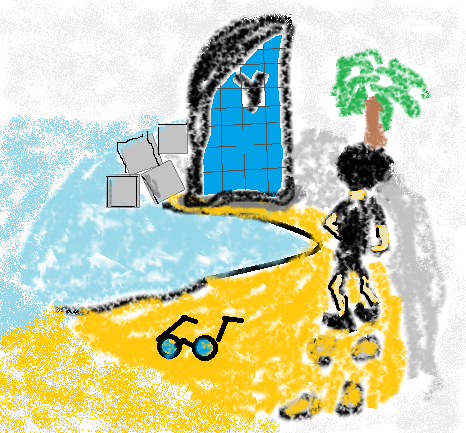
A long walk next to Barceloneta Beach brought Peter to the end of the path: the Hotel W, which locals call Hotel Vela, was located at the end of that crowded walkway. The last walkers would disappear into the entrance of that modern building, and behind it, suddenly, the crowd and noise would stop and you would find yourself standing at the dock with a pile of big rock cubes and a view of the sea. Few people at a time visited this place, which functioned as a nook for reflection. Sometimes you could see locals there, gathering their thoughts, rather than just tourists.
Peter was standing at the dock looking at the horizon. Some of his peers back home were already taking their kids to the park and hosting get-togethers with best friends on weekends. In contrast, he was lonely and felt old and exhausted. Sometimes it seemed to him that all that was missing was a senior metro card and an antique toga for him to become some kind of surreal old man visiting docks. He wanted his youth back, as it belonged to him. He flew many times to his homeland and back, trying to figure out which was his true home. Well, as psychology teaches us, all trips are in vain if a person doesn’t experience a change within themselves.
That change will come. He will realize that Barcelona is his true home. Besides that, it will turn out that Peter doesn’t hate science and engineering jobs. It’s just that the contemporary work protocols, enforced by companies, are something he needs to get used to. Just like the turbulence on his first flight to Barcelona, these protocols at the first encounter look much worse than they actually are. In fact, the “contemporary” here is purely about profit-making speed—de facto standards of industry for little engineering bees like him. Later on, he will learn that in his field, distinguished names that do not follow those standards do exist, and they are still using cutting-edge technologies.
What happens in his inner world is still superficial, little more than mere reflection. And when would an engineer, busy as he is, find time for some deeper analysis? As time goes by, this reflection will become stronger, pushing his boat into the waters of self-confrontation. And then he will be studying the literature beyond just the natal chart. However, he is still years away from that. Until then, the engineer-scientist will be chewing his spiritual crumbs.
He is now standing at the dock near the Hotel Vela. Airplanes are landing in a row carrying new expatriates and their baggage, visible and the psychological kind—invisible—piled with archetypes.
Peter is looking at the open sea. His subconscious tendency to search for meaning is getting stronger. His thoughts are traveling toward Africa.
Sailboats are emerging on the horizon. He will remember them after many years when he reads stories about boats from Galilee.
He is reflecting on a dream that he had before coming to Spain, which announced his relocation: the secret chambers of empire, hidden within the hallways of a metro station in his country’s capital. In a few years, when he reads psychological literature, he will also know exactly how to analyze that dream.
His conscious mind, standing in the present moment on the dock near the Hotel Vela, is just the tip of the iceberg. Nevertheless, his unconscious reaches beyond the frontiers of time, stretching deeply into the past and future, creating some strange entanglement between what already happened and what is yet to come.
Translated by the author Johnny B